Need an online tutor?

clevercrestacademy.co.uk
Showing posts with label pope. Show all posts

Onaiyekan to head church in Rome


THE Catholic Archbishop of Abuja, John Cardinal Onaiyekan, will assume the headship of the Church of St. Saturninus in a brief ceremony in Rome tomorrow.
This is contained in a statement issued by the Office of Liturgical Celebrations of the Supreme Pontiff at the Vatican in Abuja on Friday.
The statement said the event would take place at noon in the premises of the church on Via Avigliana 3 in Rome.
It said the cardinal would partake in all ceremonies necessary for the possession of the ‘Titular Church’.
The statement explained that a titular church is assigned to a cardinal, a priest or deacon.
“Originally, the cardinals were parish priests and deacons of Rome and bishops of suburban dioceses.
“This tradition has been symbolically preserved by appointing the cardinals as titular parish priests and deacons of Roman churches,” it said.
The News Agency of Nigeria (NAN) reported that once a church becomes titular, it remains so unless the Pope revokes the status even if there is no titular cardinal attached to it.
Congrats bishop.

Pope Francis elected as 266th Roman Catholic pontiff

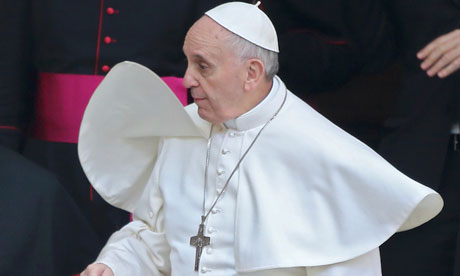
Catholic church on Wednesday chose as their new pope a man from almost "the end of the world" – the first non-European to be elected for almost 1,300 years and the first-ever member of the Jesuit order.Jorge Mario Bergoglio, the archbishop of Buenos Aires, becomes Pope Francis – the first pontiff to take that name – an early indication perhaps of a reign he hopes will be marked by inspirational preaching and evangelisation.But the cardinals' choice risked running into immediate controversy over the new pope's role in Argentina's troubled history.

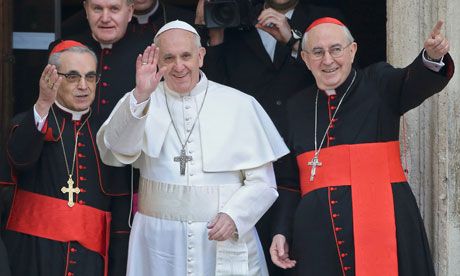
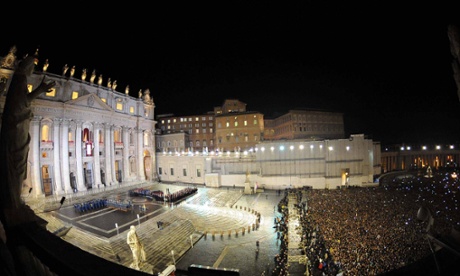
In his book, El Silencio, a prominent Argentinian journalist alleged that he connived in the abduction of two Jesuit priests by the military junta in the so-called "dirty war". He denies the accusation.The new pope appeared on the balcony over the entrance to St Peter's basilica more than an hour after white smoke poured from the chimney above the Sistine Chapel, signalling that the cardinals had made their choice. Dressed in his new white robes, the bespectacled Argentinian prelate looked pensive and perhaps a little intimidated as he looked out at the sea of jubilant humanity in the square.The former Cardinal Bergoglio was not among the front-runners. But he obtained more votes than any other candidate except former pope Benedict in the 2005 conclave, and – although his election came as a surprise – he was certainly not a rank outsider.According to some accounts, he was not chosen eight years ago because he begged his fellow cardinals not to continue voting for him. As he uttered his first words – "buona sera" – and the cheering died away, he told the crowd that his peers had been tasked with finding a bishop of Rome. "And it seems that they went almost to the end of the world to find him. But we're here," he said with a smile.

After a prayer for his predecessor, Benedict XVI, the new pope invited the faithful in the square to "pray for the entire world". He added: "I hope that this path for the church will be one fruitful for evangelisation."Faced with a sharp choice between those cardinals who wanted a thorough shake-up of the Vatican and those who did not, it appeared the electors in the Sistine Chapel opted for compromise. Bergoglio has a reputation for both political canniness and reforming drive. Among the tests facing the 76-year-old will be the awesome managerial demands of the job.

The fumata bianca – the white smoke signal that marks the successful conclusion of a conclave – arrived after five ballots at the end of the second day of voting. The smoke that poured out of the comignolo, the copper and steel tube on the roof of the Sistine Chapel, was greeted with cries of delight and applause from the crowd below. Soon after, the bells of St Peter's rang out, confirming that a new pope had taken over the spiritual leadership of the world's 1.2 billion baptised Catholics.Inside the Sistine Chapel after the final vote was cast, the most junior of the cardinals, James Harvey, a former prefect of the papal household, called in the secretary of the college of cardinals, Monsignor Lorenzo Baldisseri, and the master of papal liturgical ceremonies, Monsignor Guido Marini, to witness the new pope's acceptance of one of the most daunting jobs on Earth.The most senior of the electors, Cardinal Giovanni Battista Re, approached the pope-to-be and – in accordance with tradition – asked him in Latin: "Do you accept your canonical election as supreme pontiff?"Having obtained his consent, he will have asked: "By what name do you wish to be called?" The master of ceremonies, acting as a notary, will then have summoned two of his staff to act as witnesses, and prepared the document that certifies the new pope's acceptance.Newly elected popes are taken to be robed in the Room of Tears, its name an indication of the reluctance with which most approach the task. The last holder of the office, Benedict XVI, introduced a change in the ritual that allows the new pope to pray before he is announced to the world.Benedict abdicated on 28 February, saying that he was no longer able to cope with the burden of his office. He was the first pontiff to resign voluntarily since Celestine V in 1294.

The world's Catholics will be looking to his successor to provide not only spiritual inspiration but also firm leadership. The new pope was chosen against a background of turbulence and strife unprecedented in modern times. He takes on the leadership of a church whose faithful have been shocked by a proliferation of clerical sex abuse scandals throughout the rich world and dismayed by events in and around the Vatican.The day for the 115 cardinal-electors began at about 6.30am local time in the Casa Santa Marta, their simple but comfortable – and highly protected – residence in the walled city state. After breakfast, they made their way to the Apostolic Palace, the home of the popes, for morning mass in the Pauline Chapel. By about 9.30am, they had settled themselves into the Sistine Chapel for prayers and the resumption of voting.Benedict's startling decision to resign came after years of mounting tension and discreet but venomous infighting in the Roman Curia, the central administration of the Catholic church. Last year, some of the pope's correspondence, pointing to bitter rivalries and maladministration – or worse – in the Vatican was published in book form.Benedict's butler, Paolo Gabriele, was tried and imprisoned for leaking the documents, but the journalist to whom the papers were passed has said that his source was part of a much broader network of disaffected Vatican employees and officials. Gabriele's arrest coincided with a renewed controversy over the Vatican bank, whose chairman was summarily dismissed last May.The scandals – and a string of controversies over the pope's own declarations – distracted attention from what was expected to be the central theme of his papacy.

Benedict came to the leadership of the Catholic church as the pope who would begin the process of re-evangelising an increasingly secular western world.That too will be an important challenge for his successor. In the approach to the conclave several cardinals said they wanted a great pastor for the world's biggest Christian denomination.No indication of how or why the new pope was chosen was expected to emerge. On Tuesday, before the start of the conclave, the cardinal-electors took an oath of secrecy, as had those Vatican employees and officials involved in the election.Additional precautions included a sweep of the Sistine Chapel to ensure that no listening devices had been planted inside and the use of electronic jamming techniques.

No pope yet

Black smoke poured out of the chimney above the Sistene Chapel today, signalling that the first vote for a new pope did not succeed in settling on a new pontiff.Few expected the first vote to determine the next pope and the black smoke was not a surprise. The next vote by the Catholic cardinals is expected to be held on Wednesday.
The cardinals retreated to the Sistene Chapel in a choreagraphed procession with the 115 cardinals eligible to vote marching in two by two while singing prayers. They were dressed in white robes with short red capes and red caps known as birettas as they complied with the ancient rituals of the church and settled into assigned seats beneath the world famous frescoes created by Michelangelo for the papal conclave.The cardinals read the secrecy oath in unison, and then came forward to individually to put their hands on the Gospels and repeat an oath of secrecy ending with the words, "the holy word of God which I touch with my hand."

Cardinals to select next pope at next conclave

The process of selecting the next pope will soon be underway in Vatican City, where 115 eligible cardinals are set to decide who should become the next leader of the Roman Catholic Church.

The papal election process, or conclave, is set to begin at the Sistine Chapel in Vatican City later today.At 10 a.m. local time (5 a.m. ET) the dean of the College of Cardinals, Angelo Sodano, will lead the celebration of the "Pro eligendo Pontificie" Mass — the Mass for the election of a pope — inside St. Peter's Basilica, joined by voting cardinals.This is followed at 4:30 p.m. (11:30 a.m. ET) with a procession into the Sistine Chapel, where the cardinals will chant and take an oath of secrecy. That will be followed by a meditation delivered by elderly Maltese Cardinal Prosper Grech.Then the master of papal liturgical ceremonies gives the order "Extra omnes" — "Everyone out" — and all but those taking part in the conclave leave the chapel's frescoed walls.

Before the conclave, cardinals met 10 times to discuss the decision and issues the church is facing. Although the meetings are held behind closed doors, Vatican spokesman Rev. Federico Lombardi revealed the cardinals debated their expectations for the next pope and what his role should be.The address during the pre-conclave mass is widely believed to reflect on the cardinals' discussions during these top-secret meetings.

Sole vote Tuesday

The cardinals vote just once on the first day of the conclave, and results from that initial vote are expected around 8 p.m. local time (3 p.m. ET) on Tuesday.While it's possible for a new pope to be determined by the first vote, it is highly unlikely. For a winner to be declared, he must receive two-thirds of the vote — 77 votes in total.If more ballots are required, the cardinals will hold twice-daily secret voting sessions starting Wednesday in the chapel until Benedict XVI's successor is chosen.When they are not in the chapel, the cardinals will remain within Vatican walls, staying at Casa St. Martha, a hotel that was built while John Paul II was pope. The cardinals will eat and sleep at the hotel, isolated from the outside world for the duration of the conclave.Anyone interacting with the cardinals during the conclave — such as doctors, confessors, maids or bus drivers — swore an oath of secrecy Tuesday afternoon. If they break the oath, they will face ex-communication by the church.

No clear front-runner

It's not clear how long the conclave will take. John Paul II was elected after a two-day conclave. Benedict was elected after two days, and four ballots.Saint Peter's Basilica at the Vatican is illuminated while seen from the Tiber river in Rome. Roman Catholic Cardinals will begin their conclave inside the Vatican's Sistine Chapel Tuesday to elect a new pope.

Once the 115 cardinals — all under the age of 80 — have made their decision, the selected cardinal will be asked whether or not he accepts the position. More than one cardinal has previously refused the papacy, though not in recent history. If he accepts, he immediately becomes pope and must select a new name.
A puff of white smoke will emerge from the Sistine Chapel as the ballots are burned, and bells will ring to indicate that a new pope has been chosen. If the vote does not result in the selection of a new pope, the smoke from the chapel will be black.As of late Monday, there appeared to be no clear leading candidate who might be chosen to lead the world's 1.2 billion Catholics, but many different names have been floated as people try to determine who will be selected.Canada's Cardinal Marc Ouellet is viewed by many to be among the leading contenders. Several other non-European candidates, including Cardinal Odilo Pedro Scherer, 63, of Brazil and Cardinal Peter Turkson, 64, of Ghana, have also been mentioned as possible contenders for a job that has never been held by a non-European."The debate will be about priorities, and what the most urgent issues are," Vatican analyst David Perlich told CBC News Network on Monday as final preparations for the conclave were underway.

Perlich said there are about 10 men who stand a "really good opportunity" of being elected, but he noted that there have been surprises in the past, including Karol Józef Wojtyła, who was elected in 1978 and served as Pope John Paul II until he died until 2005.Fay said the cardinals will be looking for someone who they believe has the "charism," or spiritual grace, to carry the burden of the papacy.The direction the new pope will give the church, which has recently been plagued with multiple scandals, will be important. Over the past few years, reports of sexual abuse by senior clergy have emerged, Vatican finances have been under scrutiny, and sensitive Vatican documents were leaked, raising questions about the church's ability to thrive in the digital age.The current conclave comes after Benedict retired in late February, the first pope to do so in nearly 600 years. Benedict, who was elected pope in 2005, has promised "unconditional reverence" and obedience to the new pope as he lives out his retirement at a monastery within the Vatican.